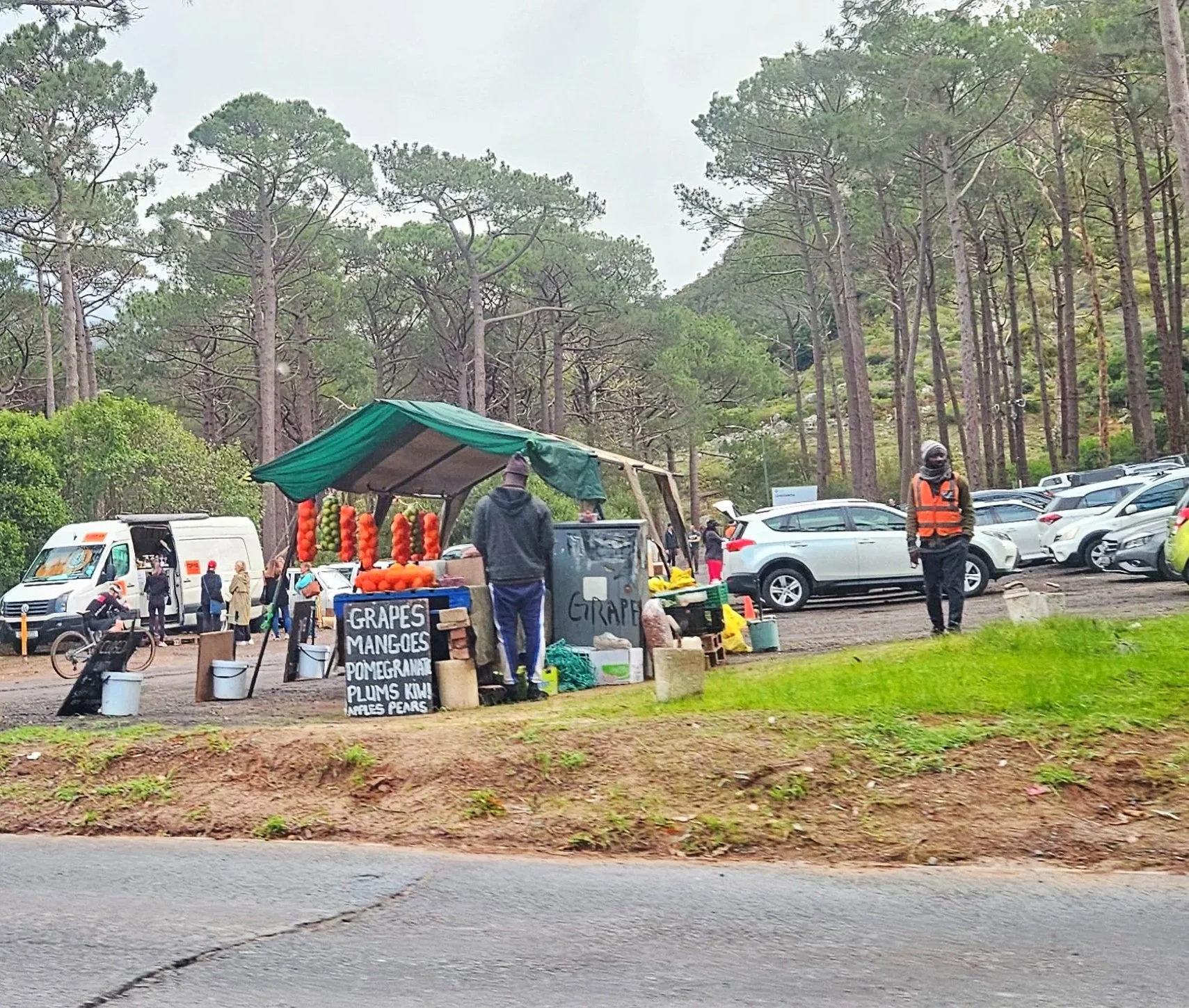
Photo of a market stool set up in a car park near a busy hiking area, taken by me
Where Food Meets Survival: A Reflection on South Africa’s Food Realities
A reflection on the lived realities of urban hunger in South Africa, where informal food economies, policy gaps, and daily precarity expose the systems that make food insecurity inevitable.
OPINION PIECE
by Alexandra Dowding
27th September 2026F
ood in South Africa is not just about what people eat, it’s about how far they travel, and what systems they navigate to survive. During my months in Cape Town, food became one of the clearest windows into inequality. Not through statistics or reports, but through observing people every day: stall holders, roadside vendors, men digging through bins at dawn. This article describes some of the interactions I had and observations I noticed during my time in South Africa.
Informal Market Survival
One conversation at the organisation I volunteered with stayed with me. We talked about the informal small market stall holders you see scattered across the city; a table of fruit next to a busy road, a makeshift stand on a pavement, a gazebo pitched at a busy intersection. Stall owners should ask permission from the local community or property owners before setting up. In reality, not all stall holders do seek permission, but if they want to stay in that area for a long period, they will seek permission to mitigate any disagreements from the community. They pitch where they feel safe, where foot traffic is steady, where the neighbourhood offers a degree of protection. These micro‑markets are survival strategies. They exist because formal systems exclude too many people, and informal economies fill the gaps left behind.
One of the most heartbreaking moments for me was learning that the people selling fruit at traffic lights; oranges, bananas, whatever they could source, would likely do that for the rest of their lives. Earning just enough to buy a small amount of food every day or two. Barely surviving. No pathway out.
South Africa confronts you with inequality constantly. People asking for money or food. People asking you to walk with them to the nearest shop so you can buy them something to eat. People sitting on corners, trying to find somewhere safe to spend their time. Hunger is not hidden, it is visible, embodied, and daily.
Urban Hunger
My early morning walks in Cape Town often began with the same scene: men and boys travelling into the neighbourhood specifically to dig through bins. They pulled out trash, tipped bins over, searched through the contents, sometimes finding scraps to chew on. Then they cleaned up, put the bin back, and walked away as if they had never been there. This is what urban hunger looks like.
People travelling across the city to search through waste because food environments are too unequal and the cost of living has outpaced people’s ability to afford the basics.
South Africa grows more than enough food. What it lacks is equitable access, affordable pathways, and governance structures that protect people from hunger. Hunger persists not because food is absent, but because systems make it inaccessible, but to change this requires redesigning the systems that make hunger inevitable.
Two Moments That Stayed With Me
1. The woman at the intersection
In the back seat of an Uber on a wide two‑lane road, we stopped at the traffic lights. Across the asphalt, three or four people crossed including a schoolboy in uniform. They emerged from a construction site where workers in hi‑vis moved in and out of an opening in the fencing.
Beside this gap, almost on the edge of the road, a woman sat under a small gazebo with her stall of fresh fruit and vegetables. A baby rested on her lap. Workers and pedestrians passed by. Cars streamed past only metres away.
Her presence at that intersection wasn’t accidental. She had positioned herself where foot traffic was constant, where people with limited means moved between work and transport. Her low‑priced fruit and vegetables were part of a fragile micro‑economy serving those navigating daily precarity.
2. The boy with the bananas
At a busy three‑lane intersection, an informal vendor, a child (probably about 10 years old) waited on the pavement for the lights to turn red. As cars stopped, he stepped into the road, weaving between vehicles, holding up two large bags of bananas. He paused briefly at each window, seven or eight seconds at most before moving to the next car. No one signalled interest.
When the lights changed, he retreated quickly to the pavement, blending back into the flow of pedestrians. His entire income depended on seconds of opportunity and the goodwill of passing drivers. The lack of sales in that cycle reflected how precarious informal food vending can be, especially for those relying on high volume, low margin items.
These moments were not isolated. They were part of a pattern, a fragile ecosystem of informal food economies that millions rely on.
What Cape Town Made Visible
Cape Town made hunger visible, in a way I couldn’t ignore it. It showed me that food insecurity is not only about what people eat, but about the systems that shape their choices:
the distance to affordable food
the instability of income
the cost of transport
the absence of safety
the lack of formal employment
the governance failures that make survival a daily negotiation
South Africa has some of the strictest policies aimed at improving food insecurity, yet there is almost no regulation, support, funding, monitoring, or implementation behind them. Without these foundations, policies become symbolic rather than transformative, they exist on paper, but no one benefits from them in practice.
These reflections stay with me as reminders that food systems are lived systems. If we want to meaningfully address food insecurity, we must transform the environments and structures that make it possible in the first place. In many cases, grassroots movements and community‑based work offer more realistic pathways to change than top down policy alone.
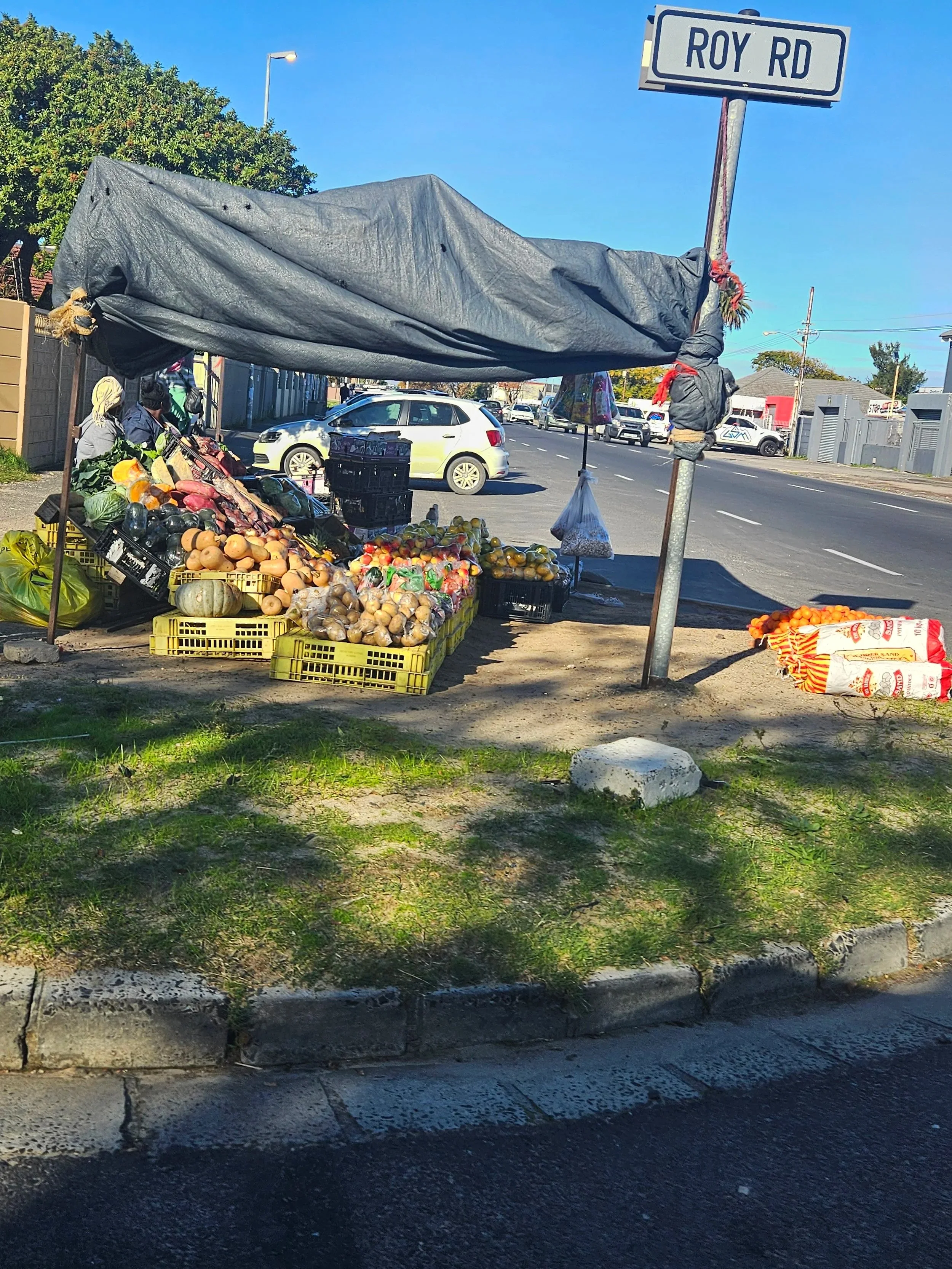
Photo of an informal market stall set up in a safer neighbourhood, on the edge of a busy road in Cape Town, taken by me